

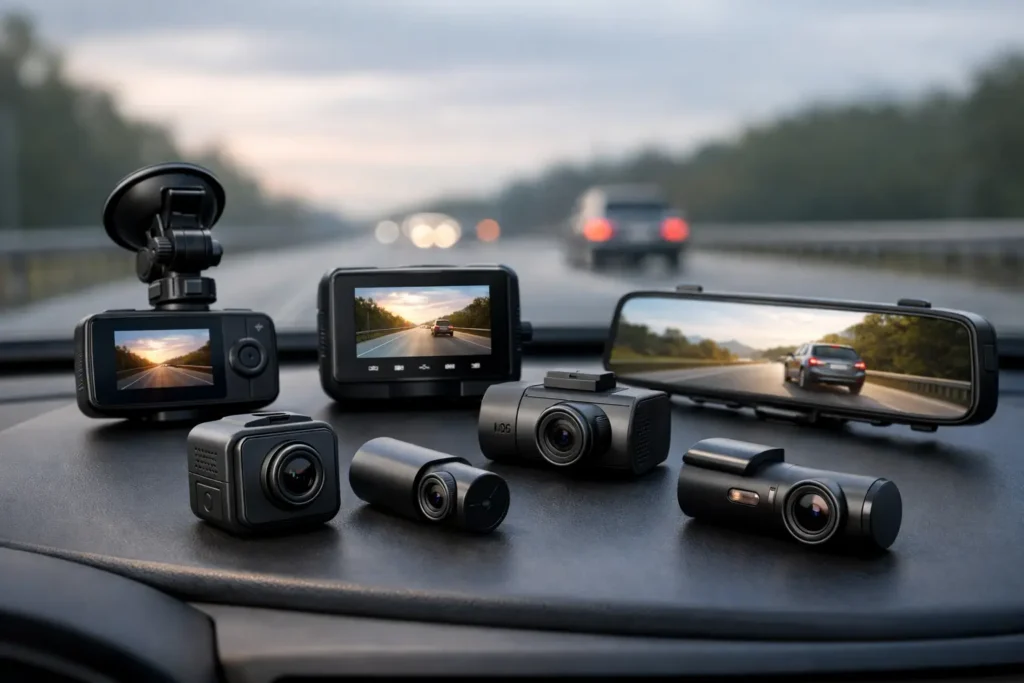
A cheap dashcam that misses a license plate at dusk is not a bargain. The best budget dashcams put clear, usable video and dependable recording ahead of flashy 4K labels, oversized touchscreens, and app features you may never use.
For most drivers, spending roughly $80 to $180 gets you a camera that can document an accident, capture a hit-and-run, or settle a dispute with an insurer. That is the useful part. The catch is that budget dashcam listings are full of inflated specs, sketchy apps, and cameras that work fine until the memory card fills up or summer heat arrives.
The picks below focus on models from established dashcam brands with a better track record for video quality, reliability, and support. Prices move often, especially during sales, so treat the price ranges as a guide rather than a promise.
The best budget dashcams for most drivers
1. Viofo A119 Mini 2 – best overall front camera
The Viofo A119 Mini 2 is the one to buy if you want strong front-facing evidence without turning your windshield into a gadget display. Its compact wedge shape sits high behind the rearview mirror, and its 2K video sensor handles night driving better than many lower-priced cameras claiming 4K resolution.
It records sharp daytime footage, manages bright headlights reasonably well, and offers useful options such as Wi-Fi, GPS control, and buffered parking mode when hardwired. Buffered parking mode matters because it can save footage from just before an impact, not only after the camera detects one.
Expect to pay around $100 to $140. The main limitation is simple: it is a front-only camera. If rear impacts or rear-end hit-and-runs are a major concern, buy a dual-camera kit instead. Also, use the included GPS privacy setting if you do not want every clip tagged with your exact speed and location.
2. Redtiger F7N – best budget front and rear kit
A front camera records who caused the crash ahead of you. A rear camera can be just as useful when someone hits your parked car, tailgates aggressively, or rear-ends you at a stoplight. The Redtiger F7N is worth considering for drivers who want both views without paying premium dual-cam prices.
Its front camera records at a higher resolution than the rear camera, which is normal at this price. The rear footage is still useful for showing what happened, even if it will not read every moving license plate at night. It includes a screen, Wi-Fi app access, and GPS features, and bundles often include a 32GB memory card.
A typical sale price is about $110 to $160. Installation takes more effort than a front-only model because the rear cable has to run from the windshield to the back window. In sedans and hatchbacks, this is usually manageable with a trim tool and patience. In SUVs with a liftgate, route the cable carefully through the factory rubber boot. Do not run it across an airbag path.
3. Garmin Dash Cam Mini 2 – best tiny dashcam
The Garmin Dash Cam Mini 2 is a good fit if you dislike the look of most dashcams. It is small enough to hide behind the mirror, has no distracting display, and starts recording automatically once installed. For commuters, rideshare drivers, and anyone with a crowded windshield, that simplicity is a real advantage.
Video is 1080p rather than 2K or 4K, so this is not the pick for the best possible nighttime plate detail. Still, the footage is generally clear enough to establish lanes, traffic lights, vehicle positions, and the sequence of an accident. Garmin’s compact design and straightforward setup are the bigger reasons to buy it.
It usually costs around $100 to $130. Keep in mind that parking surveillance requires a separate constant-power cable, and cloud storage features may involve a subscription. Skip the subscription unless you have a specific reason to need remote clip access. A good memory card and periodic checks are enough for most people.
4. Thinkware F200 Pro – best for parking protection
The Thinkware F200 Pro is a sensible choice for drivers who park on busy streets, in apartment lots, or in crowded work garages. Its video resolution is modest by current standards, but Thinkware has a strong reputation for parking-mode features and heat tolerance, two areas where very cheap cameras can disappoint.
When hardwired, it can monitor for impacts and motion while your vehicle is parked. Its voltage protection is also designed to shut the camera down before it drains the car battery too far. That does not mean it is maintenance-free, but it is a better starting point than plugging a random camera into an always-on USB port.
The front-only version can fall near $130, while front-and-rear packages cost more. It is worth the extra money only if parking incidents are your real concern. If you mainly want proof during normal driving, the Viofo offers better image quality per dollar.
5. 70mai A810 – best value for higher-resolution video
The 70mai A810 is worth a look when discounted because it offers 4K front recording and a modern sensor at a price that can undercut more familiar brands. In good daylight, it can provide noticeably more detail than entry-level 1080p cameras. That can help when you need to zoom in on a parked vehicle or street sign.
But higher resolution should not be the only reason you choose it. Night video, app reliability, heat performance, and warranty support matter just as much. The A810 is a better fit for someone willing to spend a little time with settings and verify that the camera is recording correctly after installation.
Pricing varies widely, often around $110 to $170 depending on whether a rear camera is included. Buy from a seller with a clear return policy, and do not assume the included memory card is good enough for years of use. That advice applies to every dashcam, not just this one.
What budget dashcams get right, and what they do not
A good budget dashcam can provide clear evidence of an impact, unsafe driving, a traffic signal, or a vehicle leaving the scene. It cannot guarantee a readable license plate in every situation. Plates can blur from speed, glare, rain, darkness, windshield reflections, or compression. Marketing footage rarely shows those hard conditions.
You also do not need a camera with every available feature. GPS is useful for documenting location and speed, but some drivers prefer to disable it for privacy. A screen makes setup easier, while a screenless camera is easier to hide. Cabin recording is valuable for rideshare work but unnecessary for most private vehicles.
For a typical car owner, dependable loop recording, decent night video, a secure adhesive mount, and support for a quality microSD card are more valuable than voice commands or a huge touchscreen.
Do not skip the memory card and power setup
Dashcams continuously write and overwrite video, which is harder on storage than occasional phone use. A bargain microSD card can cause recording errors, corrupted files, or random shutdowns. Choose a high-endurance microSD card from a known manufacturer, ideally 64GB or 128GB. Larger cards hold more footage, but 128GB is plenty for most front cameras and many dual-camera setups.
Format the card in the dashcam when you first install it, then reformat it periodically after saving any clips you need. Check the camera every month or two. Confirm that the date is correct, the lens is clean, and recent clips actually play. A dashcam you never test is only assumed protection.
For power, a 12V outlet adapter is the easiest route and works well for normal driving footage. Hardwiring is worth considering if you want parking mode or simply want to free up the outlet. If you are not comfortable working around vehicle trim and fuse boxes, pay for installation. A clean install costs less than repairing damaged trim, wiring, or an airbag-related mistake.
Features that are usually not worth paying extra for
Be cautious with no-name cameras advertising 8K, 12K, or impossible frame rates for under $60. Many use interpolated video, weak sensors, or aggressive image sharpening that looks impressive in a listing but fails in real conditions. A legitimate 1080p or 2K camera from a known maker is the safer bet.
Built-in batteries are another feature to avoid when possible. Capacitors generally handle hot and cold vehicle interiors better than small lithium batteries. That matters in much of the US, where a parked car can reach extreme temperatures.
Also skip cameras that rely on a rearview-mirror replacement design unless you specifically want that format. They can look tidy, but installation is more involved, fit varies by vehicle, and the screen can be distracting. A small camera mounted behind the mirror is usually the simpler, less risky choice.
The right dashcam is the one you will install correctly and check occasionally. Buy for the kind of driving and parking you actually do, use a quality memory card, and let the camera quietly do its job until you need the footage.