

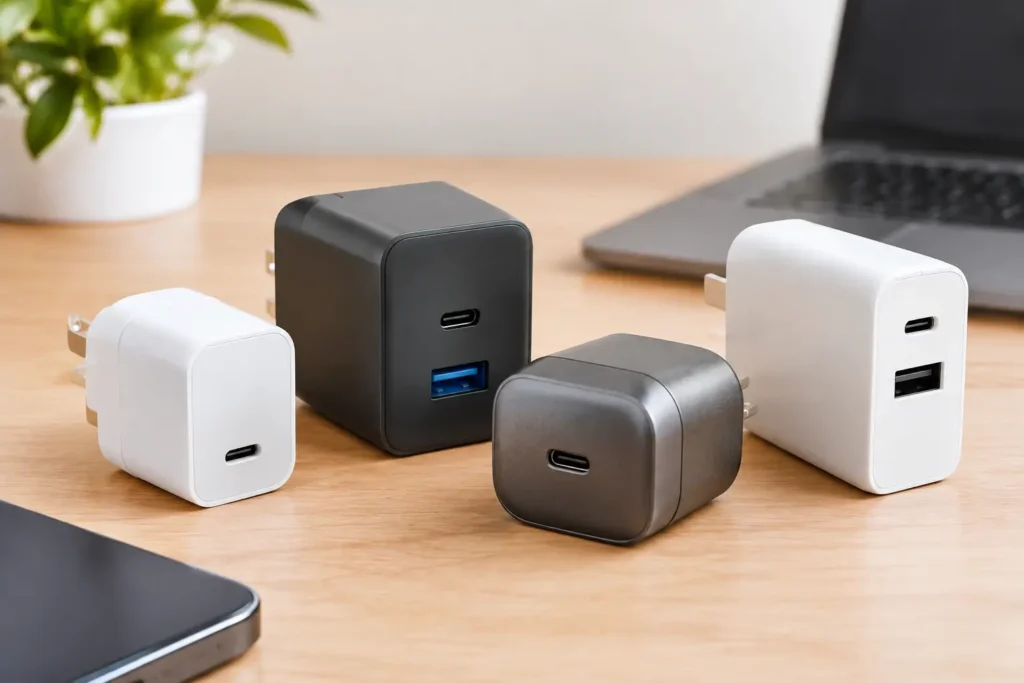
A charger takes up very little room until it is the one thing you forgot to pack. The best compact chargers solve that problem without making you settle for slow charging, questionable safety, or a bulky power brick hanging off the wall. For most people, the sweet spot is a small USB-C GaN charger with a folding plug and enough power for a phone, tablet, or light laptop.
The catch is that tiny chargers are not all equal. Some run warmer than they should, some split their advertised wattage between ports, and some low-cost marketplace models make big claims with little reason to trust them. These are the compact chargers worth considering, plus the details that matter before you buy.
Best Compact Chargers at a Glance
The Anker Nano 3 30W is the best compact charger for most phones and small tablets. The Anker Nano II 45W is the better choice if you want one tiny charger that can also handle many USB-C laptops. Need two ports? The Anker 523 Nano 3 47W and UGREEN Nexode 45W are practical travel options, though they are a little larger and slower when both ports are in use. For shoppers on a tight budget, a reputable 20W USB-C charger from a known accessory brand is usually enough for a phone.
1. Anker Nano 3 30W: Best for Most People
The Anker Nano 3 30W earns its place because it gets the basics right. It is very small, has a foldable wall plug, and provides enough USB-C Power Delivery output to fast-charge modern iPhones, Samsung Galaxy phones, Google Pixel phones, Nintendo Switch systems, and many smaller tablets.
Thirty watts is more useful than the number may suggest. An iPhone will not use all 30W continuously, but the extra capacity gives the charger room to charge quickly without being limited to an older 18W or 20W ceiling. It can also charge an iPad Air or similar tablet at a sensible speed.
Its limitation is simple: one USB-C port. If you regularly charge a phone and earbuds at the same outlet, a dual-port model may be worth the extra size and cost. Also, it is not the right pick for a MacBook Pro, gaming laptop, or any laptop that expects 45W or more. For everyday phone charging, though, this is the kind of compact charger that is actually worth your money.
2. Anker Nano II 45W: Best Tiny Charger for a Laptop
The Anker Nano II 45W is a good middle ground for travelers who carry a USB-C laptop but do not want a large 65W brick. Its single USB-C port can provide up to 45W, which is enough for many smaller laptops, including MacBook Air models, Chromebooks, and several lightweight Windows machines.
It is also an excellent charger for tablets and phones, but buying 45W only makes sense if you will use that headroom. A phone alone will not charge meaningfully faster than it does from a good 30W charger once its battery-management system reaches its preferred limit.
Check your laptop’s original charger before choosing this one. If your computer shipped with a 60W, 65W, or higher adapter, a 45W charger may still work for light use, but battery percentage can drop during demanding work. Video editing, gaming, and heavy multitasking are not where you want to undersize your charger.
3. Anker 523 Nano 3 47W: Best Dual-Port Compact Charger
A dual-port charger is more convenient than carrying two single-port bricks, and the Anker 523 Nano 3 47W is a sensible option for a phone-and-tablet travel setup. With one device connected, it can deliver enough power for a light USB-C laptop. With two devices connected, it shares its available output between them.
That last point is where many shoppers get caught out. “47W” does not mean both ports can deliver 47W at the same time. The charger has a total power budget, and its output changes depending on which ports are used. For a phone and wireless earbuds, this is no problem. For a laptop plus a tablet, expect slower charging than you would get from separate chargers.
Still, this model is worth considering if reducing outlet clutter matters more than getting maximum speed on every device. It also has a folding plug, which is more valuable than it sounds when the charger lives in a backpack pocket.
4. UGREEN Nexode 45W: Good Value Dual USB-C Alternative
UGREEN’s Nexode 45W dual USB-C charger is a strong alternative when it costs less than the comparable Anker model. It offers the same basic advantage: one compact wall charger for two USB-C devices, with enough total output for a phone and tablet or a low-power laptop setup.
UGREEN is not automatically better because it is cheaper, and it is not automatically worse because it is not Anker. Pricing is the deciding factor here. If the Nexode is noticeably less expensive, it is good value from a well-established accessory maker. If the prices are nearly identical, choose based on the port layout, warranty terms, and the model that fits more securely around nearby outlets.
Like every multi-port charger, it is best for convenience rather than full-speed charging across several power-hungry devices. Read the output chart on the package or product listing before buying. It should clearly show the wattage available with one port and with both ports connected. Skip chargers that make this hard to find.
5. A Reputable 20W USB-C Charger: Best Budget Phone Option
If you only charge one phone and want to spend as little as possible, a reputable 20W USB-C charger remains a smart buy. It is enough for standard iPhone fast charging and works well for many Android phones. You do not need a 45W or 65W charger just because a product page says “fast charging.”
This category requires more caution than the others. The lowest-priced chargers on large marketplaces are often generic units with vague brand names, copied safety claims, and inconsistent build quality. A charger is connected directly to your expensive phone and your home’s electrical outlet. Saving a few dollars is not worth gambling on an unknown power accessory.
Look for USB-C Power Delivery support, a recognized brand with clear specifications, and a folding plug if portability matters. An older 12W USB-A charger may be cheap, but it is a poor purchase for a new USB-C phone unless you already have a specific reason to use USB-A.
What Makes a Compact Charger Worth Buying?
GaN is one useful feature to look for. Gallium nitride chargers can be smaller and more efficient than older silicon designs, which is why many good 30W to 65W chargers have become pocket-friendly. But GaN is not a quality guarantee. A poorly designed GaN charger is still a poor charger.
More important is USB-C Power Delivery, often shortened to USB-C PD. This is the standard that lets compatible devices negotiate a safe charging rate. Samsung owners should also look for Programmable Power Supply, or PPS, if they want the fastest supported wired charging on certain Galaxy models. A charger can have a high wattage number and still miss PPS.
The cable matters too. A weak, worn, or USB-A-to-USB-C cable can limit charging speed. For phones, a quality USB-C cable from a known brand is usually enough. For laptops and chargers above 60W, use a cable rated for the power you need. Do not assume the cable included with an old accessory can handle it.
Common Compact Charger Mistakes
Do not buy based on port count alone. A three-port charger may sound better than a one-port model, but it can be less useful if its total output is low and every connected device charges slowly. For most people, one good 30W charger or one good 45W dual-port charger is a better purchase than a bargain four-port brick with unclear power sharing.
Also avoid treating maximum wattage as a promise of speed. Your device controls how much power it accepts. A 100W charger will not make a phone charge at 100W, and it may cost more, weigh more, and run no cooler than a properly chosen 30W model.
Finally, pay attention to fit. Some ultra-compact chargers are wide enough to block a second outlet, especially on older wall plates or crowded airport outlets. A small charger with a folding plug is ideal for travel, but a slightly longer, narrower shape can be more practical at home.
The right charger is usually the smallest reputable model that meets your real power needs. Buy 20W for a phone on a budget, 30W for a phone and tablet, and 45W when a light laptop is part of the plan. That approach keeps your bag lighter, your spending sensible, and your devices properly powered.