

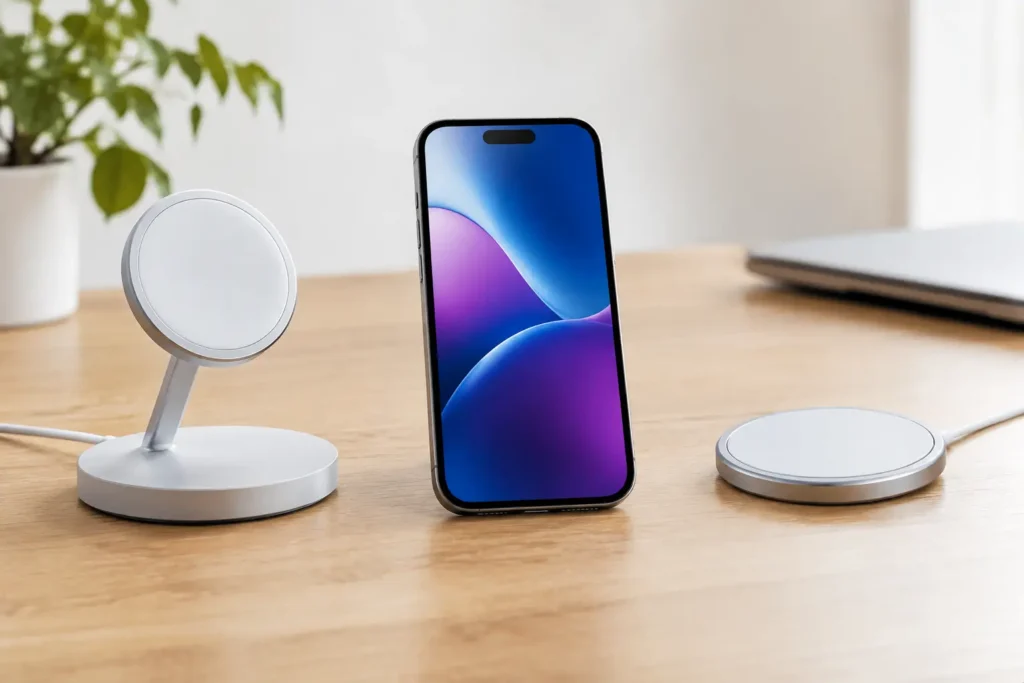
A magnetic charger that snaps into place sounds like a simple purchase. It is not. Search for one and you will find cheap magnetic pads, Qi2-certified chargers, MagSafe chargers, cases with magnets, and listings that blur all of those terms together. In the Qi2 versus MagSafe decision, the best option depends less on the logo on the box than your phone, case, charging speed needs, and how much you want to spend.
For most iPhone owners, Qi2 is the better value starting point. It delivers the magnetic alignment people want from MagSafe and is available from more brands at more reasonable prices. MagSafe still has a place, particularly if you want the fastest supported charging on a newer iPhone or prefer Apple-made accessories. Android owners need to be more careful: Qi2 support is growing, but a magnetic case alone does not make every Android phone a proper Qi2 phone.
Qi2 versus MagSafe: the practical difference
Qi2 is a wireless-charging standard from the Wireless Power Consortium. Its key feature is the Magnetic Power Profile, which uses a ring of magnets to center the phone on the charging coil. Better alignment means less fiddling, fewer failed charging sessions, and more predictable heat and charging performance than an ordinary flat wireless pad.
MagSafe is Apple’s magnetic accessory system for iPhones. It introduced the familiar magnetic ring used by chargers, wallets, stands, battery packs, and car mounts. Apple also licenses MagSafe to accessory makers, although many products described as “MagSafe compatible” are not certified MagSafe chargers.
That wording matters. A product can have magnets strong enough to hold an iPhone and still be limited to slower standard Qi charging. It may work fine for overnight charging, but it is not equivalent to a certified Qi2 or MagSafe charger.
The simplest way to think about it is this: Qi2 is an industry standard designed to bring reliable magnetic wireless charging to more brands, while MagSafe is Apple’s system. They overlap heavily for iPhone users, but they are not identical.
Charging speed is where the fine print matters
The original Qi2 standard supports up to 15 watts on compatible devices. That is a meaningful improvement over the 7.5-watt limit often seen with basic Qi charging on iPhones. A 15-watt magnetic charger is practical for a desk, bedside table, or travel bag. It will not beat a wired USB-C charger, but it is convenient enough that you may actually use it.
Newer Qi2 2.2 products can support up to 25 watts, but only when both the phone and charger support that version and profile. Do not assume every charger labeled Qi2 reaches 25 watts. Many affordable models are still 15 watts, which is not a problem if the price reflects it.
Apple’s newer MagSafe chargers can also deliver up to 25 watts on supported newer iPhones when paired with an adequately powerful USB-C power adapter. Older iPhones and older MagSafe accessories may top out at 15 watts. If fast wireless charging is your reason for spending more, verify the exact phone generation, charger model, and required adapter before buying.
Also, a charger advertised as “up to 15W” may not include the wall adapter needed to reach that number. A weak old USB-A brick or a low-output USB-C adapter can turn a decent charger into a slow one. For a 15-watt magnetic charger, a reputable 20-watt USB-C Power Delivery adapter is usually a sensible baseline. For a 25-watt model, follow the charger’s stated adapter requirement, which may be 30 watts or higher.
Which one is better for iPhone owners?
For an iPhone 12 or later, a Qi2-certified charger is usually worth your money. It magnetically attaches, can provide 15-watt charging on compatible iPhones, and is often less expensive than Apple’s official MagSafe puck. It is especially good value if you need a charging stand, car mount, multi-device station, or power bank, since third-party Qi2 options offer more choice.
Choose Apple’s MagSafe charger when you have a newer iPhone that supports its higher wireless charging rate and you genuinely want that extra speed. It is also a safe choice if you want the least compatibility uncertainty. Apple accessories tend to cost more, though, and that premium does not automatically make them the best buy for overnight charging.
A certified third-party MagSafe charger can also be worth considering, but check what it is certified to deliver. Some are built around earlier 15-watt MagSafe specifications. Others may cost nearly as much as Apple without offering better materials, a better cable, or a useful stand design.
For iPhone owners who charge while sleeping, the smart budget move is usually a solid 15-watt Qi2 stand or pad from a known accessory brand. Spending extra for 25 watts makes more sense for a desk charger you use during the day, when short top-ups matter.
What Android buyers should know
Qi2 is potentially much more useful for Android than MagSafe because it is not tied to Apple. But the market is still uneven. Some newer Android phones include native Qi2 support, while many popular models do not. In those cases, a magnetic case can let the phone attach to a Qi2-style charger or mount, but the phone’s actual charging speed and behavior still depend on its own wireless-charging hardware.
This is the most common bad purchase: buying a “MagSafe-compatible” case for an Android phone, then assuming it delivers Qi2 charging. The case provides magnetic positioning. It does not add certified Qi2 electronics, improve the phone’s wireless charging limit, or guarantee that every magnetic accessory will align correctly.
If you use Android, check three things before ordering: whether your phone supports Qi2 natively, whether your case is designed for your specific phone, and the maximum wireless charging speed your phone allows. If the phone only charges at 10 or 15 watts wirelessly, paying extra for a 25-watt Qi2 charger will not make it faster.
For Android car mounts, a magnetic case and a well-built Qi2-compatible mount can still be a good setup even if your phone lacks native Qi2. Just buy from a brand that clearly states compatibility and has proper heat management. Wireless charging in a hot car is already hard on performance. A flimsy mount with weak magnets and questionable electronics is not worth the savings.
Certification matters more than marketing language
When comparing chargers, look for clear Qi2 certification or official MagSafe certification. Avoid listings that only say “magnetic wireless charger,” “for MagSafe,” or “MagSafe style” if you expect reliable 15-watt charging. Those phrases can describe anything from a decent basic Qi pad with a magnet ring to a poorly made charger that runs hot.
A low price is not always a bargain here. Wireless chargers handle power and heat close to your phone’s battery. Skip no-name products with vague specifications, no stated safety certifications, very short cables, or reviews that mention repeated disconnects. A charger that saves $10 but charges unreliably is not good value.
Cases matter too. A thick case, a misaligned magnet ring, or a metal plate used for an older car mount can interfere with charging. For the best results, use a case specifically labeled Qi2 or MagSafe compatible for your exact phone. It does not need to be expensive, but it needs accurate magnet placement.
Do you need Qi2 or MagSafe at all?
Not necessarily. A wired USB-C charger remains cheaper, faster, cooler, and more efficient. If you want the quickest charge for travel, gaming, or a phone that is nearly empty, use a good wired charger and cable. Wireless charging is mainly a convenience feature.
Magnetic wireless charging earns its keep when it removes small daily annoyances: placing your phone on a nightstand without checking alignment, keeping navigation visible in the car, or using a stand at work that lets you glance at notifications. If those uses fit your routine, Qi2 is a worthwhile upgrade over a standard wireless pad.
For a basic overnight charger, do not overbuy. A certified 15-watt Qi2 model from a reputable brand is the sensible choice for most people. Pay for faster MagSafe or Qi2 2.2 charging only if your exact phone supports it and you will benefit from daytime top-ups. The right charger is the one that works reliably with your phone and case, not the one with the most impressive claim on its product page.