

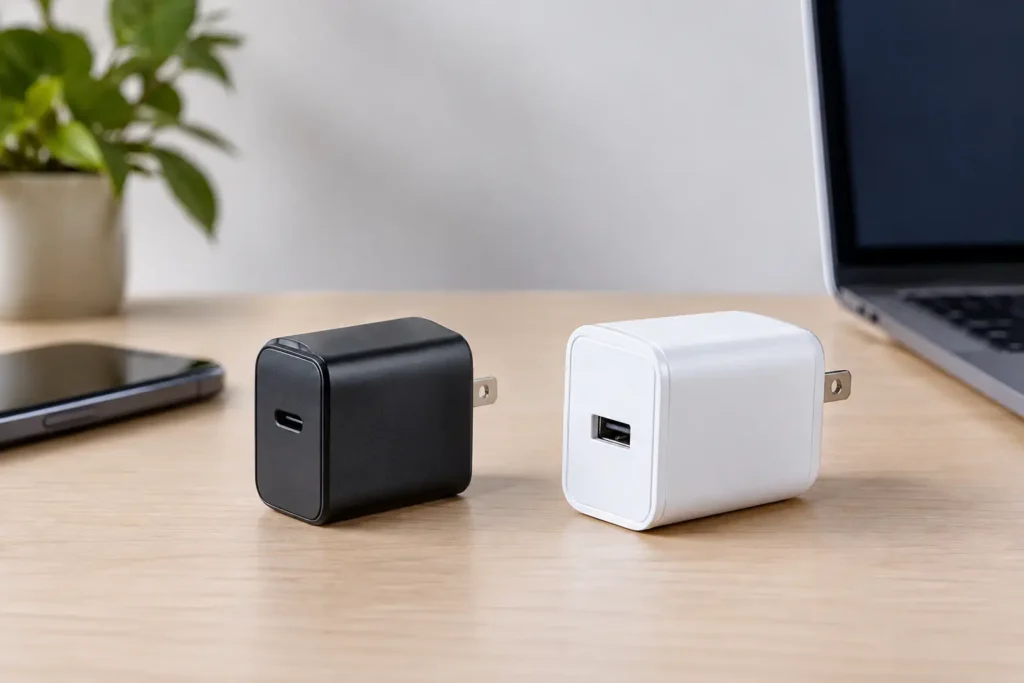
A GaN charger versus standard charger comparison matters most when your old charging brick is large, runs hot, or cannot keep up with a newer phone, tablet, or laptop. The short answer: a good GaN charger is often worth paying a little more for, but it is not automatically faster or safer than every standard charger. The wattage, charging protocol, ports, cable, and brand quality still matter.
The quick answer: when a GaN charger is worth buying
GaN stands for gallium nitride, a material used inside some newer chargers instead of the silicon used in most traditional models. It lets manufacturers make compact chargers that deliver a lot of power without turning the charger into a heavy wall brick.
For most shoppers, GaN is worth considering if you travel, carry a laptop, want one charger for several devices, or need more power from a crowded power strip. A 65W GaN charger can be small enough for a jacket pocket while handling many USB-C laptops, a phone, and a tablet one at a time.
A standard charger is still good value if you only charge one phone overnight, already have a reliable charger, or can buy a reputable basic model for much less. Do not replace a working 20W phone charger just because the box says GaN. You may see no meaningful difference in charging time.
GaN charger versus standard charger: the real differences
The technology inside affects charger size and efficiency more than it changes what your devices can do. Both types can safely charge compatible devices at their rated speed when they are designed and certified properly.
GaN chargers are usually smaller for the same wattage
This is the most noticeable benefit. Gallium nitride components can switch electrical current more efficiently at higher frequencies than conventional silicon components. That allows charger makers to use smaller internal parts and shrink the overall housing.
At low power, the size advantage may be minor. A 20W GaN phone charger might be only slightly smaller than a comparable silicon charger. At 45W, 65W, or 100W, the difference can be substantial. That is where GaN makes the most practical sense.
A smaller charger is useful for travel and crowded outlets, but check the shape before buying. Some tiny high-wattage chargers are heavy enough to sag out of loose wall outlets. A compact design is not always the most convenient design.
Charging speed depends on watts and protocols, not the GaN label
This is the buying mistake to avoid. GaN does not magically make a phone charge faster. A 30W GaN charger and a 30W standard charger that both support the right USB-C Power Delivery profile should charge a compatible device at roughly the same speed.
Your device sets the limit. An iPhone, Android phone, tablet, Nintendo Switch, or laptop only draws the amount of power it is designed to accept. A 100W charger will not force 100W into a phone that accepts 20W or 27W.
For fast charging, look for USB-C Power Delivery, often called USB-PD. Programmable Power Supply, or PPS, is also worth having for many Samsung Galaxy phones and other Android models because it can improve charging efficiency and support the phone’s preferred fast-charge mode. If a listing only says “fast charger” without naming its USB-PD or PPS support, treat that as a warning sign.
Both can get warm, and neither type is automatically safer
A well-made GaN charger is efficient, but it can still feel warm when charging a laptop or powering several devices. Its smaller body has less surface area to spread heat, so warmth is not necessarily a defect.
What matters is whether the charger becomes uncomfortably hot, smells like burning plastic, makes a buzzing sound, repeatedly disconnects, or has damaged casing. Stop using it if you notice those problems.
The safety difference is mostly about build quality, not silicon versus GaN. A cheap, poorly made GaN charger can be less dependable than a reputable standard charger. Look for a recognized safety testing mark appropriate for US use, clear electrical ratings, a known manufacturer, and a return policy that is not a hassle to use. Skip suspiciously cheap no-name chargers with inflated wattage claims and vague product descriptions.
GaN can be more efficient, but do not expect a dramatic electric-bill change
GaN chargers generally waste less energy as heat, especially at higher outputs. That is a real benefit, but it will not noticeably transform your home electricity bill. The bigger payoff is getting high wattage in a smaller, lighter charger.
Efficiency also varies by model and workload. A quality silicon charger may outperform a poorly designed GaN charger. Do not buy based on one spec label alone.
Multiport charging is where shoppers need to read the fine print
A multiport GaN charger can replace separate chargers for a phone, tablet, earbuds, and laptop. That can save outlet space and reduce the number of accessories in your bag. It can also create confusion when the advertised wattage is shared between ports.
For example, a charger labeled 65W may provide the full 65W to one USB-C port when it is used alone. Plug in a phone on a second port, and the laptop port may drop to 45W while the phone receives 20W. That is normal, but the exact split should be listed in the product specifications.
This matters for laptops. Many compact laptops work fine at 45W or 65W, though they may charge slowly during demanding work. Larger laptops often need 90W, 100W, or more to charge properly while in use. Gaming laptops frequently use proprietary power adapters and may not perform well from a USB-C charger at all.
Also expect some multiport chargers to briefly reset or renegotiate power when you plug in another device. A short charging interruption can be normal. Frequent disconnects are not.
Your cable can ruin an otherwise good charger
A charger cannot deliver its full potential through a weak or outdated cable. USB-C cables are not all built for the same power level, even when they look identical.
For phones and small tablets, a quality USB-C cable is usually enough. For a 60W or 65W laptop setup, use a cable rated for at least that power. For 100W or higher charging, use a clearly labeled 100W or 240W USB-C cable from a reputable brand. Some higher-power USB-C cables include an electronic marker that tells the charger and device what they can safely handle.
Do not assume a USB-A to USB-C cable can provide modern USB-C PD charging speeds. Many cannot. If fast charging matters, USB-C to USB-C is usually the safer choice.
Which charger should you buy?
Choose a GaN charger if you want the smallest practical charger for 45W or more, travel regularly, or want one dependable multiport charger instead of several separate bricks. It is especially good value when replacing a laptop charger and phone charger at the same time.
Choose a standard silicon charger if your needs are simple. A reputable 20W USB-C charger for one phone is usually cheaper, widely available, and perfectly adequate. A larger standard charger may also be easier to grip and less likely to pull out of a loose outlet.
For a phone-only buyer, prioritize the correct wattage and USB-PD or PPS support before paying extra for GaN. For a laptop-and-phone buyer, prioritize enough total wattage, clear port-sharing details, and a cable that matches the job. GaN is then a useful bonus because it keeps the charger from taking over your bag.
A practical buying checklist
Before spending money, confirm four things: your device’s preferred charging wattage, the fast-charging protocol it uses, how many devices you will charge at once, and whether you already own a cable rated for the required power. Those details prevent far more bad purchases than choosing between GaN and standard technology alone.
Avoid chargers with impossible-looking claims, such as a tiny two-port model promising huge wattage for a bargain-basement price. Also avoid assuming a USB-C port means laptop charging. Some ports are limited to low output, while others are intended mainly for data.
A GaN charger is a smart upgrade when its smaller size and higher power solve a real problem for you. Otherwise, a good standard charger from a trustworthy maker remains one of the simplest, best-value accessories you can buy.