

A cheap charger is easy to replace. A phone, laptop, or handheld damaged by a poorly made one is not. That is why GaN chargers versus standard chargers is more than a specs question. For most shoppers, the real issue is whether a GaN charger provides enough practical benefit to justify its higher price.
The short answer: a good GaN charger is often worth buying when you need compact size, higher wattage, or multiple USB-C ports. But GaN is not automatically faster, safer, or better value. A well-built standard charger can still be the smarter purchase for a single phone or low-power device.
What makes a GaN charger different?
GaN stands for gallium nitride, a material that can handle power more efficiently than the silicon used in many standard chargers. That efficiency lets manufacturers make chargers smaller while still delivering substantial wattage.
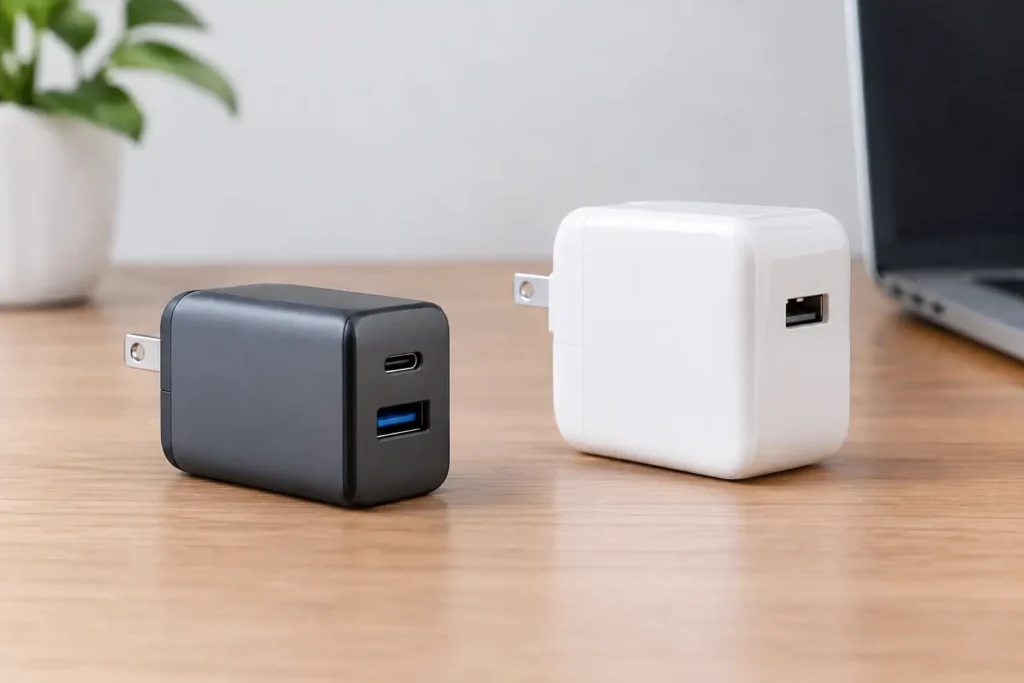
A 65W GaN wall charger can be small enough to fit in a pocket yet powerful enough for many USB-C laptops, tablets, and phones. A traditional silicon charger with similar output is usually larger and heavier. This is the biggest everyday advantage of GaN, especially for travel, crowded power strips, or anyone who wants one charger instead of several.
The important catch is that GaN describes the internal power technology, not the entire quality of the charger. It does not guarantee good components, safe construction, accurate power output, or support for the charging standards your devices need.
GaN chargers versus standard chargers: the differences that matter
Size and portability
GaN wins clearly on size at higher power levels. If you need 45W, 65W, 100W, or more, GaN makes it much easier to carry one compact charger for a laptop and phone.
At 5W to 20W, the difference is less dramatic. A basic 20W standard charger is already small, inexpensive, and easy to pack. Paying extra for a tiny 20W GaN model may not make much sense unless its shape fits your outlet or travel bag better.
Charging speed
GaN does not make a device charge faster by itself. Your device only draws the power it is designed to accept, and the charger must support the right charging protocol.
For example, a 20W GaN charger and a 20W standard charger will usually charge the same compatible iPhone at roughly the same speed. Likewise, a 65W GaN charger will not force a laptop that accepts only 45W to charge at 65W.
Look for USB Power Delivery, usually shown as USB PD, when buying for newer phones, tablets, handheld gaming devices, and USB-C laptops. PPS support can also matter for some Android phones, particularly models that advertise higher fast-charging speeds. A charger can use GaN and still lack the protocol your phone needs for its best charging speed.
Heat and efficiency
GaN chargers are generally more efficient, which can mean less wasted energy and a smaller charger body. They can still get warm, though. A compact 65W or 100W charger working hard will often feel hot to the touch, particularly when charging two devices at once.
Warm is normal. Too hot to comfortably touch, a burning-plastic smell, buzzing, intermittent charging, or discoloration are not normal. Stop using a charger with those symptoms, whether it uses GaN or standard silicon.
A larger standard charger may sometimes run cooler simply because it has more physical room to spread out heat. So do not assume the smallest GaN charger is automatically the best choice for long, high-wattage charging sessions.
Ports and shared power
Many GaN chargers offer two or three USB-C ports, sometimes with a USB-A port added for older accessories. This is useful, but the headline wattage can be misleading.
A charger labeled 65W may provide the full 65W through one USB-C port. Plug in a phone on the second port, and the laptop port may drop to 45W while the phone gets 20W. That is usually normal behavior, not a defect. Check the port power split printed on the charger or listed in its specifications before buying.
This matters most for laptop users. A 45W laptop may charge slowly or lose battery during demanding work if its port is reduced to 30W when another device is connected. For a phone, earbuds, smartwatch, or e-reader, shared power is usually less of a concern.
When a standard charger is the better value
A standard charger is not outdated just because GaN exists. It is often the better budget choice when you only need one port and modest power.
If you are replacing a basic phone charger, a reputable 18W to 30W USB-C PD charger is usually enough. The money saved may be better spent on a quality USB-C cable, which is just as important for reliable charging.
Standard chargers can also be a sensible choice for permanent spots around the house: beside the couch, at a desk, or in the kitchen. A slightly larger charger is not a big inconvenience when it rarely moves. If the price gap is substantial, there is no reason to pay a premium just for GaN branding.
When a GaN charger is worth your money
GaN becomes more compelling as your charging needs increase. It is worth considering if you travel, use a USB-C laptop, carry a handheld gaming device, or want to reduce the number of chargers in your bag.
A 45W GaN charger is a practical middle ground for many shoppers. It can handle most phones and tablets with room to spare, and it may charge compatible smaller laptops. A 65W model is a better all-purpose pick for many USB-C laptops plus a phone. For larger laptops, check the manufacturer’s required wattage before assuming a 65W unit is enough.
Higher-output models, such as 100W chargers, can be useful but are not always a bargain. They make sense for power-hungry laptops or multi-device setups. For a phone and tablet, they are usually overkill.
Do not buy GaN based on the label alone
The budget charger market is full of vague claims. Some no-name models advertise unrealistic wattage, use questionable safety components, or have unreliable ports that loosen after a few months. A GaN label does not fix any of that.
Choose chargers from established accessory brands or manufacturers with a track record of clear specifications and dependable support. For US use, look for appropriate independent safety certification markings such as UL, ETL, or TÜV. A marking is not a perfect guarantee, but its absence on a high-wattage wall charger is a reason to be cautious.
Also check that the plug is firmly attached, the housing has no gaps, and the product clearly states its output profiles. A listing that only says “fast charge” without showing wattage by port is not giving you enough information.
Avoid ultra-cheap high-wattage chargers from unfamiliar sellers. Saving $10 is not good value if the charger delivers unstable power, overheats, or fails early.
Your cable can limit charging, too
A new GaN charger cannot overcome a poor cable. Older USB-C cables may support only 60W, while some cheap cables are poorly made and may not reliably handle even their claimed output.
For phones, a quality USB-C to USB-C cable from a reputable brand is usually enough. For laptops that need more than 60W, buy a cable rated for 100W or higher. If you are shopping for a 140W-capable setup, the cable requirements become more specific, so verify compatibility rather than assuming every USB-C cable will work.
Cable length matters as well. A long cable can be convenient at a hotel nightstand, but it is more likely to be bulky and may be lower quality at the cheapest price points. Buy the length you actually need.
The practical buying decision
Buy a standard charger if you need an affordable, reliable single-port charger for a phone or small accessory. A reputable 20W to 30W USB-C PD model is usually good value and will meet most everyday needs.
Buy a GaN charger if compactness matters, you want to charge a laptop, or you want one charger for several devices. For most people building a travel setup, a trusted 45W or 65W GaN charger offers the best balance of size, flexibility, and price.
Do not pay extra for a huge wattage number you will never use. A dependable charger with the right USB PD or PPS support, enough power for your devices, and a good cable is worth more than a flashy GaN model with questionable specifications. Buy for your actual devices and habits, not the biggest number on the box.