

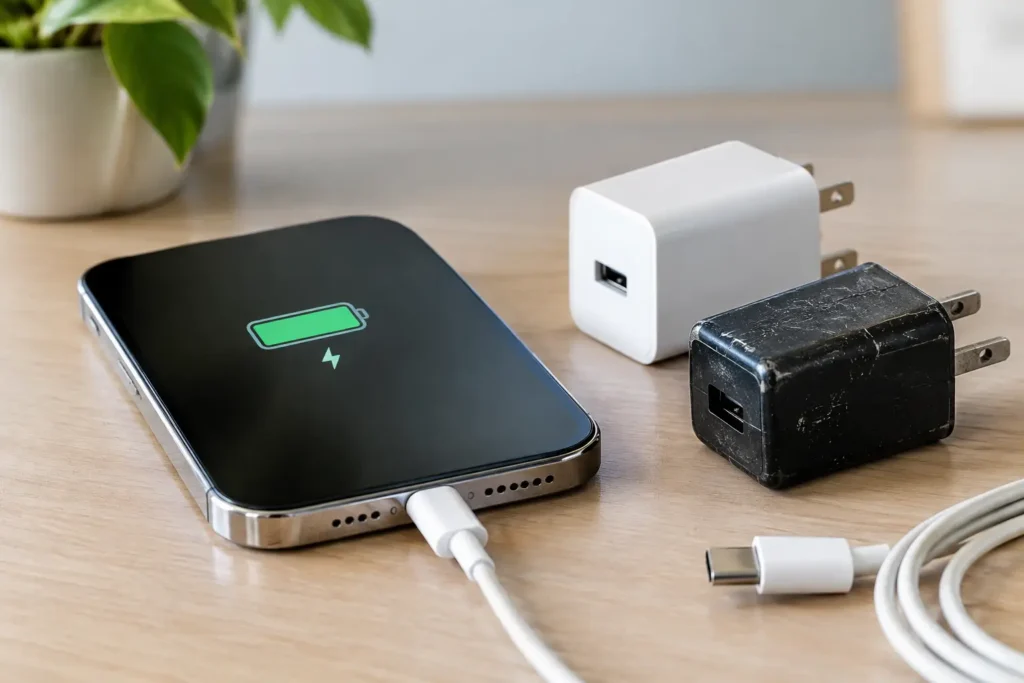
Do cheap chargers damage phones? Some can, but the price alone is not the problem. A $10 charger from a reputable accessory brand may be perfectly safe, while a no-name charger with fake safety markings, poor internal parts, and no meaningful quality control can put your phone, battery, and even your outlet at risk.
The practical rule is simple: buy affordable chargers, not mystery chargers. You do not need to pay premium-brand prices for every charging brick, but this is one phone accessory where the absolute cheapest option can become expensive fast.
How cheap chargers can damage a phone
Your phone is designed to manage charging. Modern iPhones and Android phones communicate with compatible chargers, request the power they need, and include protections against overcharging. That means a basic, low-power charger usually will not force too much electricity into your phone just because it is plugged in.
The risk comes when a charger does not deliver stable, properly regulated power. A poorly made unit can have weak insulation, low-quality capacitors, inaccurate components, or inadequate heat control. Those issues can cause voltage spikes, unstable charging, excessive heat, or repeated connection and disconnection.
Your phone’s internal charging circuitry may handle a brief problem. It should not have to compensate for one every night. Over time, excessive heat and unstable power can stress the battery and charging system. In a worst-case failure, a bad charger can damage the charging port, cause battery swelling, or create a fire hazard.
That does not mean every inexpensive charger is dangerous or that one use will ruin a phone. The more common result is less dramatic: slow charging, a charger that runs hot, unreliable charging, or a product that fails after a few months. Still, those are useful warnings, not minor annoyances to ignore.
Cheap chargers vs. good-value chargers
There is a meaningful difference between cheap and affordable. A good-value charger saves money because the brand sells at a reasonable margin, uses a simpler design, or skips premium packaging. A bad cheap charger saves money by cutting corners you cannot see.
A reliable budget charger should clearly state its wattage, supported charging standards, and electrical input and output ratings. For USB-C charging, look for USB Power Delivery, often written as USB PD. Many Android phones also use USB PD, although some brands reach their fastest speeds only with their own proprietary charger. iPhones use USB PD for fast wired charging through USB-C.
Clear specifications do not guarantee quality, but missing or confusing specifications are a red flag. If the listing makes big claims such as “100W super fast charging” while the tiny print is vague, inconsistent, or absent, skip this one.
Safety certification matters too. For US shoppers, a charger may carry marks from a recognized testing organization, such as UL or ETL. Be careful here: counterfeit products sometimes print logos they did not earn. Buy from a known retailer or an established accessories brand when possible, and treat a suspiciously low price as a reason to look closer.
Heat is the biggest everyday warning sign
Phone batteries naturally warm up while fast charging, especially when the screen is on, the phone is in a thick case, or you are using navigation, gaming, or video at the same time. A little warmth is normal.
A charger that becomes too hot to comfortably touch is not normal. Neither is a phone that gets unusually hot every time you use one specific charger. Heat is hard on lithium-ion batteries. It speeds up battery wear and, if it becomes excessive, can trigger safety shutdowns or battery damage.
If you notice heat, unplug the charger and stop using it. Do not assume it will settle down after a break. Test with a known-good charger and cable instead. If the problem disappears, the old accessory is the likely culprit.
Signs a charger is not worth keeping
Replace the charger if you notice any of these problems:
- A burning smell, buzzing, crackling, discoloration, or melted plastic.
- The charging connection repeatedly starts and stops without moving the cable.
- The charger, plug, or phone becomes unusually hot during ordinary charging.
- The charging speed is inconsistent, or your phone warns that the accessory is unsupported.
- The prongs are loose, the USB port feels wobbly, or the casing has split open.
Do not try to get extra life out of a charger that has physical damage. A $15 replacement is far cheaper than a damaged phone or an electrical problem at home.
The cable can be just as important
People often blame the charging brick when the cable is the actual problem. Very cheap USB-C cables can have thin wiring, loose connectors, weak strain relief, or incomplete support for the charging speed they advertise. A damaged cable can cause slow charging, intermittent charging, heat at the connector, and wear on the phone’s port.
For basic phone charging, you do not need an expensive cable. You do need one that matches your use. A USB-C cable used with a higher-wattage laptop charger needs the proper rating. A cable marketed only for charging may not support data transfer well. If you use a USB-C to Lightning cable for an older iPhone, choose one made for that connector rather than an unverified bargain-bin option.
Inspect cables periodically. Bent connector tips, exposed wire, stiff or cracked insulation, and a cable that only works at a certain angle all mean it is time to replace it.
Can a high-watt charger hurt a phone?
Usually, no. A reputable 45W, 65W, or even higher-watt USB-C PD charger can safely charge a phone that only needs 20W or 30W. The phone and charger negotiate a compatible power level, and the phone takes only what it supports.
This is one reason a well-made multiport USB-C charger can be a better buy than several ultra-cheap single-port chargers. It can charge a phone, tablet, earbuds, or a small laptop while using recognized power standards.
There are limits. Some multiport chargers reduce the available wattage when several devices are connected. That is normal if the manufacturer explains how power is shared. What is not normal is a charger that makes unrealistic speed claims or gives no total wattage information at all.
Wireless chargers deserve the same caution. Cheap wireless pads may charge slowly, run hot, or have poor coil alignment. They are less likely to send improper voltage directly through a cable, but unnecessary heat can still wear down a battery. For overnight charging, a dependable lower-speed wired or wireless charger is often easier on the battery than repeatedly cooking it on a hot pad.
What to look for when buying on a budget
You can avoid most charger problems without spending much. Start with the right connector and power standard for your phone. For many current phones, a USB-C PD charger in the 20W to 30W range is enough for fast charging. Paying for 100W makes sense only if you also plan to charge a compatible tablet or laptop.
Next, prioritize a recognizable manufacturer with clear product information and a real warranty. That does not mean you must buy directly from your phone maker. It means you should be able to identify who made the charger, what it supports, and where to get help if it fails.
Be cautious with marketplace listings that use copied photos, awkward wording, inflated wattage numbers, or hundreds of near-identical brand names. Reviews can help, but do not trust a high star rating by itself. Look for comments about long-term reliability, heat, fit, and actual charging speed.
Also consider where and how you charge. A compact charger for a travel bag does not need to power every device you own. A bedside charger should be dependable and run cool. A car charger needs a secure fit and stable power, especially if you rely on it for navigation. Buying the right affordable charger for the job is better value than buying the cheapest one and hoping.
If you already used a questionable charger
Using a suspicious charger once does not automatically mean your phone is damaged. Stop using the accessory if it ran hot, smelled odd, charged erratically, or triggered a warning. Then charge your phone with a known-good charger and cable for a few days.
Watch for persistent overheating, unexpected battery drain, charging interruptions, or a loose charging connection. Those problems can also come from a worn battery, a dirty port, software issues, or a damaged cable, so do not assume the charger is the only explanation. If symptoms continue with a reliable charger, have the phone inspected.
The best budget charger is not the one with the lowest sticker price. It is the one that charges your phone safely, stays cool, lasts long enough to earn its cost, and does not make you wonder whether tonight’s charge is worth the risk.